Self-Sabotage and Needless Suffering

What if I told you that suffering was an option? Would you think I was crazy? Who in their right mind would make the conscious choice to suffer? My answer would be many of us. Probably most of us.

What I’m about to tell you definitely falls into the TMI (Too Much Information) category, but it’s the freshest example in my mind at the moment. My parents live ~3 hours away, and since my mother’s surgery I’ve been driving to visit them every other weekend. Each trip I bring the road trip necessities – snacks and drinks. Unfortunately I drink most of my beverage in the first half of the drive. This part of the trip is on the interstate where there are many exits with gas stations, restaurants, and places with bathroom facilities. The second half is driving through the countryside where the options include shabby looking buildings or a tree. It never fails that the need for a bathroom hits in the populated area right before the land of a million trees but not bathrooms begin. Do I make the smart decision and stop while I have the chance? No. I continue driving and go through a cycle of debating whether to stop at the dilapidated building or find a bush. Neither are a viable option so I suffer the last half of my drive until I make it to my parents’ house. By making the conscious choice to continue driving and not stop at a place I feel comfortable, I by default am choosing to suffer the discomfort of finishing the remainder of the trip with a full bladder.

This past trip was different though. This trip I broke the cycle. I decided I wasn’t going to suffer when I didn’t have to – I stopped at a place I felt safe before I entered no-man’s land. Can we prevent every moment of suffering? No, of course not. Nor should we want to – moments of growth and evolution come from suffering. Do we need to suffer needlessly? Absolutely not.

Some of us seek out suffering. There’s a million reasons why – we feel we deserve to suffer, we punish ourselves, we’re addicted to being a victim, we crave the thrill that comes from it, we like the attention we receive when people comfort or empathize with us. There are millions of different reasons just as there are millions of things we do everyday to suffer needlessly.

Another one I’m guilty of is noticing on my way home from work that I won’t have enough gas to make it back to work the next day. I pass at least 6 gas stations on my commute, yet every time I say, “oh I’ll just get it in the morning…” And of course the next morning I’m cussing myself because I’m late and now have to stop for gas. Being late is another layer btw…

If I do some soul searching as to why I do these things I can see that I’m way too focused on short-term rewards then long-term gains. I want to do what I want in the moment instead of setting my future self up for success. Then add that while nerve-wracking the extra drama that comes from these moments gives me some excitement in an otherwise monotonous day. It gives me topics of conversation to discuss with coworkers. There are benefits, but at what cost?

What would life look like if my focus was doing things now in the moment to help myself have an easier time in the future? Personally, I think I would feel more productive therefore more motivated and focused. When I end my needless suffering I feel at peace, more energized, and that my resiliency is stronger. If you’re constantly running around putting out fires you’ve ignored eventually they will be all-consuming. I get overwhelmed and then just give up before I get started. And it didn’t have to be that way, but those are the consequences of my choices!

To sum it all up….We all suffer in life whether it be physically or emotionally. We can’t avoid all suffering – the human experience is filled with it – again, it’s the catalyst for growth and evolution. But, sometimes we set ourselves up for needless suffering out of our own ignorance of being in this cycle, or the desire to receive something (excitement, sympathy, the thrill of overcoming a challenge, etc.).

It’s up to us to becomes aware of what cycle we’re caught up in, the reason behind it, and how we’re going to break the cycle so our future selves will thank us and feel set up for success. This is your challenge for the week:

  • What are the cycles you’re in?
  • What purpose do they serve?
  • How are you going to break the cycles?

Then let’s take it one step further…

  • How are you going to get the attention, love, excitement, etc. that you’re craving?
  • How can you stop self-sabotaging?

The Power of Your Inner Child

Story time…

Each summer my parents would send my brother and I to spend a week or two with our grandparents. I loved staying with my Mimi. She was a widow in her 60s who made sure our time together was good, quality time. She came from humble beginnings in rural East Tennessee – 3rd grade education and a distinct Appalachian drawl when she spoke.

During one particular visit I had an experience with her that isn’t a warm fuzzy memory. It was scary, and had the potential to be traumatizing. As all children, you can imagine that at age 3 I wasn’t always “on my best behavior.” I don’t remember exactly what I did, but I distinctly remember my grandmother getting frustrated with me and threatening to “set me on fire.”

“I’m gonna set you on fire” is one of those lovely Southern indicators that a spanking of epic proportion is on the way. Add in her Appalachian accent, and I misunderstood what she was saying. As a small child with a small child’s insight and intellect, I thought she was literally going to start a fire and sit me on top of it. My cheeky reply to her threat was, “Well I won’t sit on it.” Lucky for me my response made her laugh and the spanking was avoided, but imagine what would have happened if that response only served to fuel her anger and she followed through with the threat. My grandmother was a safe space for me in many regards, and had never hit me before. If (through the eyes of a three-year-old who worshipped her) she had just threatened to “set me on fire” and then broken that sense of safety, how would I have felt? The panic of being threatened with physical pain, especially without knowing the reason why I was being punished, plus losing the feeling of safety with a beloved adult, what kind of anxiety could have manifested from that? I’m looking at all adults who are still scared of getting in trouble here…

All the little things that happen during childhood impact the adults we are becoming and/or have become. I had a client once who came into my office with his wife for marriage counseling. Her complaint was that he didn’t communicate. At all. He literally would not talk at the times she desperately wanted to hear his voice and thoughts. I looked at him and asked, “Who taught you it was not safe to talk?” He thought for a moment and began telling various stories about things his father would do and ways he would treat him as a child. “Eventually I stopped talking because what was the point?” As a child, he began to believe it was easier to stay quiet because his words were not important.

When we grow up and enter into new chapters of our lives, those old beliefs and behaviors don’t magically disappear or fix themselves. He carried the belief that speaking his truth was pointless and he wouldn’t be heard into his marriage. The unhealed, unheard 12-year-old inside him still kept telling the grown version of him that communication was not a useful tool available for him. Can you imagine allowing a 12-year-old dictate the dynamics of your marriage? How about a 3-year-old? Yet this is the very thing that is happening within all of us at any give time if we haven’t worked on healing our inner child.

We continue to have people come into our lives to test our beliefs developed in childhood. Each time it’s an opportunity for us to realize a certain belief, or way of thinking doesn’t work for us anymore. I know for myself when I’m tested, I can feel that anxiety, the old familiar warning that something is going on that I don’t like. But what I’ve started realizing is that what I don’t like is continuing to behave the way I did as a child to avoid the conflict. What I really want to do is speak my mind, stand up for myself, say no, etc, but I would stop myself. I stopped myself because 12-year-old me believed that it’s a waste of time. I would just be a victim again.

There is an adult version of you and a child version of you all residing in one body. Like Russian dolls. Conjure the image of an angel on one shoulder and a devil on the other. Now replace one with the adult you and replace the other with you as a child. The adult you is saying “I want this experience,” but the child you is say, “whooooa don’t you remember when x, y, z happened?”

As children, because we have very limited power, ability, resources, support, knowledge, etc., we often were made to feel like victims of our situations. I have no power, therefore I’m powerless. I’m powerless so I must protect myself however I can even if that means not using my voice or avoid everything that makes me feel unsafe. When we grow up and enter new chapters of our lives, those old beliefs and behaviors don’t magically disappear or fix themselves. We don’t always realize the power we have, and carry this victim mentality into adulthood with us.

Take time this week to reflect on the events of your childhood that shaped your beliefs. How do these events continue to affect your decisions and behaviors? What messages does your inner child tell you?

Anticipation and Emotions

As a child, the biggest night of my year was Christmas Eve. In our house, Christmas Eve was the night Santa came to deliver our presents. My brother and I would wake our parents up at the butt crack of dawn so we could race into the front room to see the loot left behind. There were two simple, yet strictly enforced rules for the chunk of time where we went to bed Christmas Eve and woke up Christmas morning.

  1. We were not (repeat NOT) to go into the front room without both parents present at the doorway Christmas morning;
  2. Once we went to bed Christmas Eve night we were to stay there under threat of Santa skipping our house and taking our presents with him.

These were the only two rules set by my parents that I never tested the limitations.

I would lie awake in bed straining to listen for Santa working in the front room or faint jingles of reindeer bells. My mind making a mental note of every toy I’d picked out in the JCPenney’s special Christmas edition catalog and daydreaming of playing happily with each one.

The worst part of Christmas morning was standing outside the front room, staring at the closed door waiting for one parent or the other to be ready and present to open the door to the wonderland on the other side. The anticipation of what was to come always ate at me and I could never understand why they weren’t as excited or anxious as I was.

Finally sweet relief when the last straggling parent would show up and we would get the green light to go in…. And wow! Look at this! Look at that! Thank you Santa for my new Cabbage Patch Kid! …but wait…what about the Easy Bake Oven I asked for? Or the My Little Pony I wanted? First world brat problems, I know.

The new toys I’d gotten didn’t seem as exciting once the disappointment had set in. They were stupid even, and I didn’t even really want them, I wanted the toys I didn’t get. I was too focused on what I didn’t have, focused on the disappointment, angry that my brother had gotten what he had asked for and more (even though really I had too).

Reality just didn’t add up to the picture I had created in my mind. That happens to us all the time. We create a scenario or fantasy about a situation or how a person is going to be. Sometimes it happens as we pictured it, but most times it doesn’t.

I usually associate daydreams and fantasies with positive things: the knight in shining armor who rescues me, sinking the winning shot, winning the big award…when they don’t happen the way we picture them we are left with disappointment. But, we create scenarios in our head that are negative too. Afraid to drive because we’re afraid we’ll get into a wreck, misinterpreting a look a friend gave us to mean they’re mad at us, or getting up to give a presentation and totally flubbing our words.

Now what about the really dark scenarios we create? I once had a panic attack because my parents didn’t answer their phones for a few hours. In my mind, the only logical explanation for this was because they were dead. I can only imagine the bewilderment on my dad’s face when he finally answered the phone on the twentieth call to me hyperventilating and crying hysterically.

If you have anxiety and panic attacks I imagine you do this too. My chest feeling tight automatically means I’m having a heart attack. My boyfriend looked at another girl so he’s going to cheat on me. I did bad on this project for work so they’re going to fire me. We jump to the worst case scenario. For me, I jump to the worst case scenario because I need to maintain a sense of control. I need to be emotionally prepared. What’s my biggest fear? My parents dying. It’s too painful and overwhelming of a thought, so in my mind it’s like creating these scenarios will help me be emotionally prepared for it to happen.

But what agony! I couldn’t function! And, it was all for nothing. They were fine. They were having a game night with their friends while I was sitting on my couch inconsolable. Our brains can’t tell the difference from us catastrophizing and from us actually facing a physical threat to our lives. Our brains will release all the chemicals we need to help us survive a bear attack – an actual physical threat – and our body has no choice but to ride the wave of those chemicals. I’ll talk more about this in a later post.

Back to anticipation…

When I got the call from my dad on June 4th that they had found a mass on my mom’s brain I had a complete meltdown. For days. Because I was facing one of my biggest fears. A tumor on the brain? In my mind it meant death. She was going to die, and die within days. I threw myself into anticipatory grief.

Anticipatory grief is a real thing. I was mourning her while she was still alive. She’s walking around cracking jokes hours after brain surgery, and I’m only focused on the image I was creating in my mind about what life would be like when she’s gone.

If there’s anticipatory grief, then there’s other emotions we anticipate…anxiety, anger, and sadness for example. Keep track of how many times you do this – positive and negative. What emotions do you feel while you’re fantasizing or catastrophizing? How do those emotions affect your behavior?

We can think and imagine ourselves into depression; into an anxiety attack and a rage. I can picture how I think interactions with a person will go and can work myself up into a rage. Without even speaking to the person! Then what happens when I finally do speak to them? I’m already poised for a fight and can make it into something more than it had to be.

Thoughts, feelings, and behavior all go hand-in-hand. Change one and they all change. In either direction. That’s what I was saying in my previous blog about gratitude. Even when we’re faced with our worst fears, we have to stay grounded in the moment and face reality for what it truly is – not the warped reality our fear has created in our mind.

Focus on the positive. Focus on the truth. Create a mantra to say to keep you grounded. After I realized what I was doing with my mother, I created the mantra:

“In this moment I am safe. In this moment everything is OK.”

It may literally be a moment-by-moment situation that you’re in, but staying present and grounded is your foundation to being resilient and not allowing yourself to slip into the downward spiral.

This week’s challenge? 1. Create your grounding mantra. 2. Keep a record of the scenarios you create in your mind and how they affect your thoughts, emotions, and behaviors.

Gratitude: Looking for the Light

Imagine being shipwrecked and floating aimlessly at sea. Now imagine a monstrous storm rolling in. Tossing, flipping, churning, rain and waves assaulting from every angle. Now tell me all the things you’re grateful for.

*cue record scratch*

I know, I know…. Your ship has sunk, you’re floating alone on debris in the middle of the ocean, you don’t know where you’re going, when you’ll get there, etc. etc. etc. All these terrible things and here I am asking you to make a list of all the things you’re grateful for.

I get it. I’m angry. I’m heart-broken. My world as I know it is ending. I don’t want to be grateful because I’m not grateful this is happening at all. I don’t want any Pollyanna B.S. right now. I’m floating on the debris in the middle of the ocean. I don’t want to be having this experience to begin with. But here I am having it. Just because I don’t like it doesn’t free me from having to accept it.

I accept it because this is my reality right now. Acceptance doesn’t mean I’m happy about it. Acceptance doesn’t mean I like it. Or that I’m just going to roll over and let it take over my life. I accept my reality for what it is in this moment.

So now I have 3 choices. I can bury my head in the sand and try to pretend it isn’t happening. I can take on the role of the victim and wallow in depression and self-pity. Or, I can, however begrudgingly, find meaning, purpose, positive growth and change, educate myself and face whatever awaits me.

The old me, my younger self was definitely a wallower. If I’m honest, I go through phases of all 3 of those options on a regular basis, but I don’t allow myself to stay long in the first two. It does no one any good if I stay in bed all day, every day and allow myself to slip down the spiral of depression. For my fellow Neverending Story fans, remember what happened to Artax in The Swamp of Sadness? That’s us when we wallow.

The first step when in darkness is to look for the light. Even when in the darkest storm. We find this light by using gratitude. It may be hard, but what are you thankful for? What do you appreciate? It could be a person, a pet, a seemingly simple but often overlooked victory. Even if all you can list is “I’m grateful I can breathe easily and freely. I’m grateful for my dog. I’m grateful I have full use of my arms and legs.” Start where you are and build from there. Search for even the faintest spark of light.

Here’s my list so far:

  • I’m grateful for my parents who have always loved and supported me unconditionally.
  • I’m grateful for a partner who loves, supports, and encourages me and my dreams.
  • I’m grateful for the 39 years I’ve had so far with my parents.
  • I’m grateful for the family and friends who have rallied around us and continue to support us.
  • I’m grateful the tumor was located in an area of the brain that made it operable.
  • I’m grateful that, minus some relatively minor side effects from the surgery, my mother is the same person when she came out of surgery as she was when she went into surgery.
  • I’m grateful for modern medicine, excellent treatment, knowledge, and skills of the care team.
  • I’m grateful for holistic health practices and my mother being open to prioritizing her health.

There are so many things to be grateful for once the list begins. And as I wrote it, I began feeling the tightness in my chest ease little by little. The truth is that whatever we surround ourselves with shades or perception of reality. If I focus on the negative then my reality will be darker and harder to traverse. Practicing gratitude doesn’t keep the suffering at bay, but it does help to light the way to acceptance.

So this is my challenge to you – find at least 5 things to be grateful for everyday. Comment below with your 5 for today.

The Art of Falling Apart

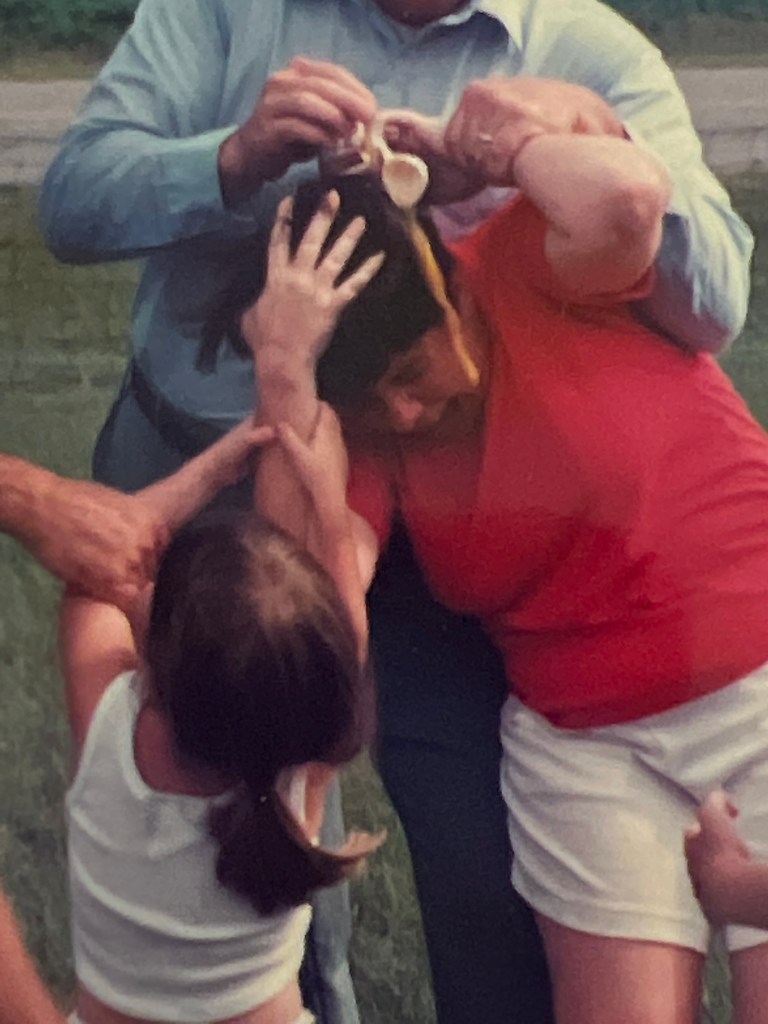
There’s a picture of me as a child. I’m about 3 or 4 years old, ponytail askew and hair disheveled. The moment captured on a classic 80s Kodiak print from the local drug store or print shop. My family and I laugh about it now, but in that moment I was terrified. I was angry. I was fighting a grown man and trying desperately to protect my mother. The back story is that we were at church camp and this man was playfully trying to crack a raw egg on my mom’s head. She was screaming in a playful protest, but with my child perception she was in distress and that was unacceptable.

Fast forward 30+ years and with one single phone call I’m that scared little girl again. But this time the man is an oncologist. The egg is a brain tumor. And I want to fight as I did as a child. But I don’t know how. My brain is white noise and my arms are flailing, punching into the air. Hitting nothing but my own grief, fear, worry. Pain that can’t be numbed. Grief that can’t be comforted despite everyone’s best attempts. I’m being sling-shot against my will into a new realm of growth and maturity.

These are the moments where everything you’ve practiced and prepared for in your healing journey to this point test you. I have my tool box of coping skills ready, I have my support group, I’m eating right, sleeping well, taking my medications, prioritizing my self-care…I’m doing everything by the book. Will it keep me from falling apart emotionally? Maybe…maybe not. Maybe the whole point of events like this is to fall apart. To have an authentic, unscripted human experience. Grieve. Cry. Scream. Emote it all out until the feelings are released. We aren’t meant to be emotionless robots, Stepford bots who don’t have the whole gambit of human emotions. Fall apart if you must, and then piece by piece reassemble yourself. Take a shower. Eat. Drink water. Take deep breaths. Distract yourself. Laugh.

Too many times we don’t give ourselves permission to have the meltdown we need or to show our vulnerability. We believe strength equates a stiff upper lip and pretending that nothing is wrong. We hold ourselves together with trembling arms until fatigue sets in and we drop to the floor. One way or another it will come out. It’s our choice whether we release it slowly like a controlled burn, or it rages suddenly like an uncontrolled forest fire devouring us.

Honestly, if someone would try to remind me to count to 10 or breathe during one of my meltdowns I would (and have) tell them to stick their coping skills where the sun doesn’t shine. Are they wrong to remind me? No. Do the coping skills help? Yes, that’s why we therapists teach and promote them. But, in the middle of a panic attack, meltdown, tantrum, whatever you want to call your experience, you’re simply focused on survival in the moment. Focused on finding a resolution for whatever triggered you.

There’s a few more layers to this, and we’ll get more in-depth as we go, but until then…find the appropriate place and time and surrender. Allow yourself to feel whatever you need to feel. Have a good cry, take a deep breath, and begin processing and coping with what happened.

Resources

If you need help processing here are some resources:

Intro: It Is What It Is

As you may have read, I’m Sarah. I am a mental health professional with anxiety and scattered showers of depression. It’s been a thing since I was a young child. I say thing because I feel to call it a “struggle” or a “battle” or even a “mental health issue” gives it more power. You, of course, are free to label yours anything you’d like. Personally, it’s already consumed enough of my life, so I simply call it a “thing.” In the famous words of the blessed saint Paula Abdul…it is what it is.

My vision, initially, for this blog was something more upbeat and bordering on being overly optimistic. Toxic positivity is a “thing” too ya know. But, as life so often does, it’s turned into a different project with a different voice. You see, you’ve caught me in the middle of my life being turned upside down, and I feel being anything other than authentic in this moment is a lie. So, instead I’m going to be honest. I’m not going to pretend to be an expert cuz ummm hello… I’m just going to be as raw and vulnerable as my anxious, broken heart will allow me to be.

I will speak my truth with hopes that you will glean words of encouragement, ideas for improvement or ways to do things differently, or if nothing else, a bit more courage to speak your own truth.

I can’t promise lollipops and rainbows, but if you’re here then I suspect you know that isn’t the world we live in all the time. But, I do promise information, suggestions, and a supportive environment to those willing to work on themselves.

Wishing you love, light, and good meds if you need them…

Sarah