Today was an exciting day for me. I had my first photoshoot (as I’m choosing to call it) for my children’s book, King Zara, that will be featured in our local magazine. I’ve been fussing about this thing ever since I was told about it. I bought a new outfit, new makeup, new shape-wear (IYKYK), hair products, jewelry…you name it I bought it. I wanted to present myself a certain way; to look the part of professional therapist and children’s book author.
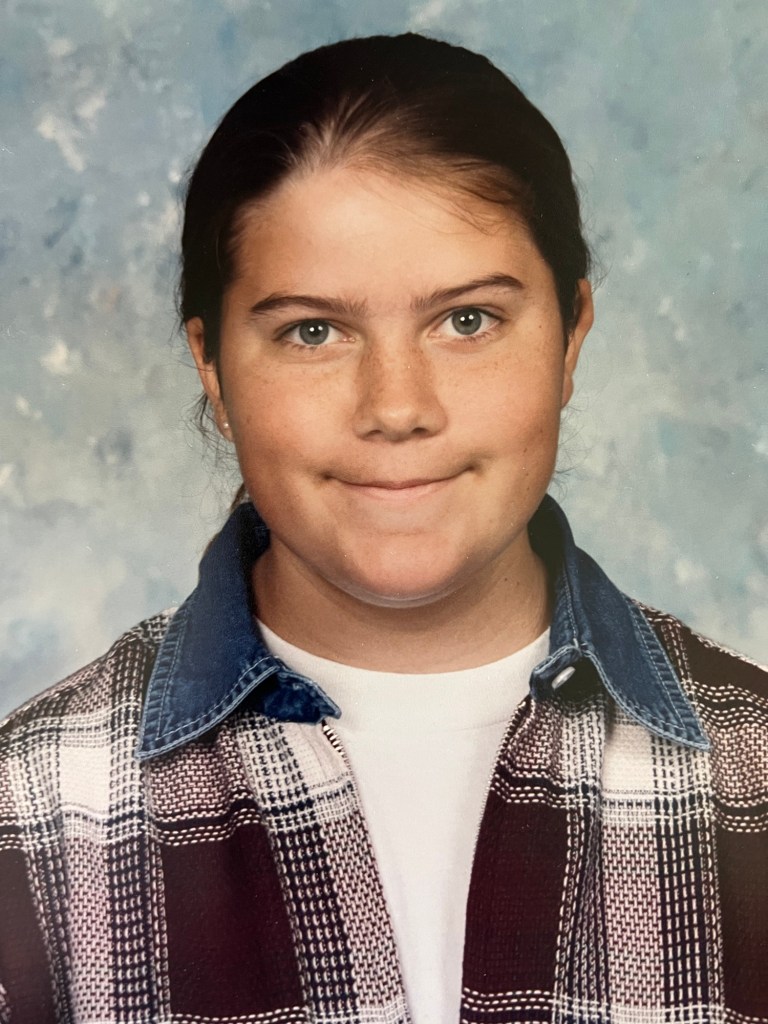
I found myself in a mini-meltdown last night because nothing was good enough. The outfit made me look frumpy…I don’t even know how to do my hair and makeup…I was putting all the pressure on myself to be and look like something I’m not. All those past insecurities were creeping in. The insecurities of wanting to hide because I didn’t feel pretty, I didn’t feel safe putting myself in a magazine to be scrutinized. I had just spoken to the journalist about my struggle with social anxiety as a teenager and how I’ve worked through it, how I want to help others embrace themselves, and here I am….well, struggling. I felt like that 13 year old version of myself who always wore her hair in a ponytail, wore a letterman jacket year around, and refused to go anywhere because she was scared.
My instinct told me to keep it simple. To stop putting pressure on myself. So I wore something I felt comfortable in, I kept my makeup minimal to my skill level, and I wore my hair down as I always do. I decided to be myself. I decided to accept myself and my abilities for what they are. And it was a relief. Choosing authenticity felt so much better than the anxiety of trying to force myself to be someone I’m not.
P. S. 13 year old me would be mortified that I’m sharing my school picture. She is a part of my story, and she deserves to be loved even if she doesn’t feel worthy.
After years of the rough draft sitting in my treasure box, after a year and a half of going through the publishing process, my children’s book has finally launched! I am thrilled…I am nervous…I am vulnerable…I am slightly in shock even though I’ve known this was coming!
I started writing when I was a child. I can remember typing out stories on my dad’s old word processor, feeling so self-important and serious as I sat at my antique desk watching the tiny green screen as the words I typed popped up. I came across one of my old stories that I printed out recently…and had the biggest belly laugh. Let’s just say that I always said that I had symptoms of ADHD as a child and this story was irrefutable proof. In true Sarah style is was a dramatic beginning, had no relevance to the title, and the ending came way too quickly leaving the reader completely and irrefutably confused.
I have many, many, many stories that I have started but never finished. King Zara was a first, and is a project near and dear to me because it is the story of me; the story of my own struggles in childhood and as an adult. Hence the nervousness and the feelings of being vulnerable. My creative projects have mostly been done in private – a remnant of my social anxiety. I may want to put my art out into the open, but my fear of exposing myself overrides this desire.
You can imagine how I’ve been feeling about having to release this book – to show everyone how I’ve been feeling most of my life and showing a piece of my work for praise and scrutiny. But, you can’t sell books if people don’t know about it right? I’ve been marketing myself on social media and have sent off press releases. Trying the think outside the box, I’ve created videos that I’ve posted on TikTok and Reels for Facebook. I’ve been riding the wave of positive feedback, praise for the book, and people showing their support online for this achievement….then here it came….the first negative comment.
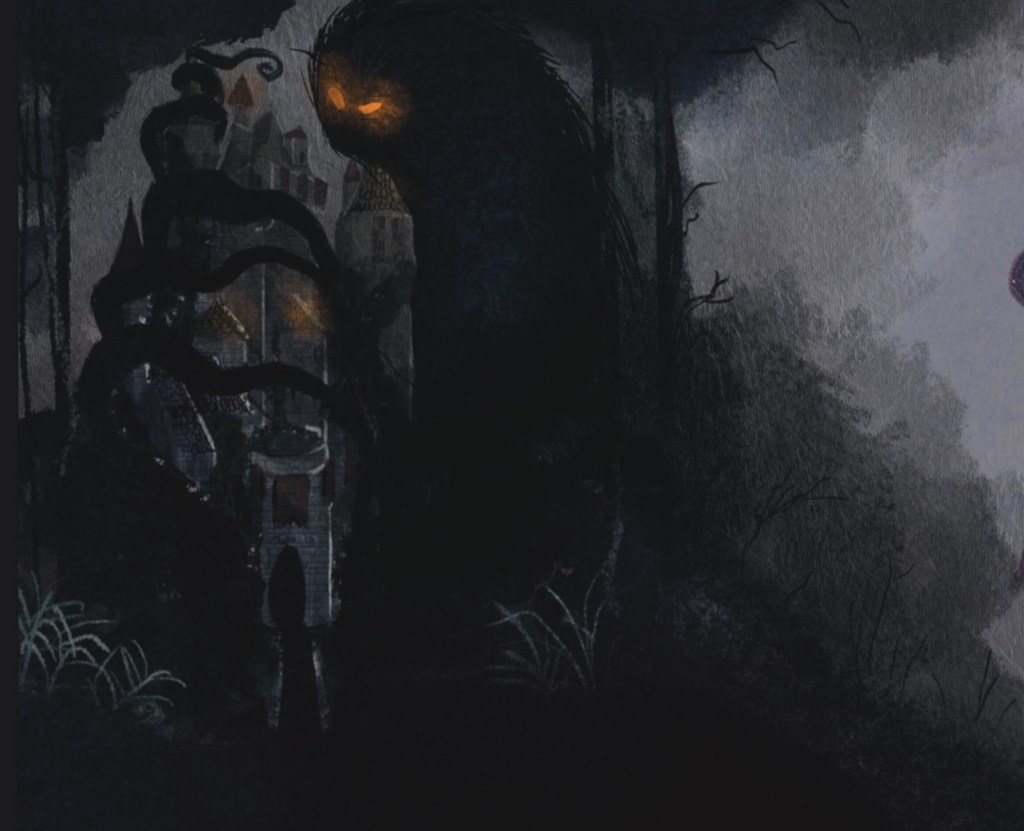
I was nauseated reading it. This person was obviously a troll, a stranger watching my Reel and spewing whatever fool comments came to his mind. I deleted it quickly, but his allegation was serious and disgusting. It was clearly dark, negative comments from a dark, negative person. As I started spiraling, I remembered the whole point of my book…monstrous people feed off of negativity and create darkness. I wrote King Zara to encourage children (and their parents) to not cave in to darkness; to fight against it and let light and love rule the day. This is why I wrote the book, and I choose to revel in the love and support of my family and friends instead and not let the darkness win.
“I’m going to ask you a series of questions and I want you to answer them from the following choices: no days, some days, most days, everyday.”
The nurse proceeded to give me a quick depression inventory. A depression inventory is a psychometric test that checks the severity of depression. It’s a list of questions that you answer – from there your answers are scored to determine if and how severe your depression may be. My answers surprised even myself. Feeling the need to justify and explain away my answers I blurted out “It’s just grief!”
I realized as soon as I said it that it doesn’t matter if it’s “just grief,” I’m still experiencing classic symptoms of depression – situational or not.
According to the Diagnostic and Statistical Manual of Mental Disorders (DSM-5), people experiencing five or more of the following symptoms during the same 2-week period and at least one of the symptoms should be either (1) depressed mood or (2) loss of interest or pleasure:
Depressed mood most of the day, nearly every day.
Markedly diminished interest or pleasure in all, or almost all, activities most of the day, nearly every day.
Significant weight loss when not dieting or weight gain, or decrease or increase in appetite nearly every day.
A slowing down of thought and a reduction of physical movement (observable by others, not merely subjective feelings of restlessness or being slowed down).
Fatigue or loss of energy nearly every day.
Feelings of worthlessness or excessive or inappropriate guilt nearly every day.
Diminished ability to think or concentrate, or indecisiveness, nearly every day.
Recurrent thoughts of death, recurrent thoughts of suicide without a specific plan, or a suicide attempt or a specific plan for committing suicide.
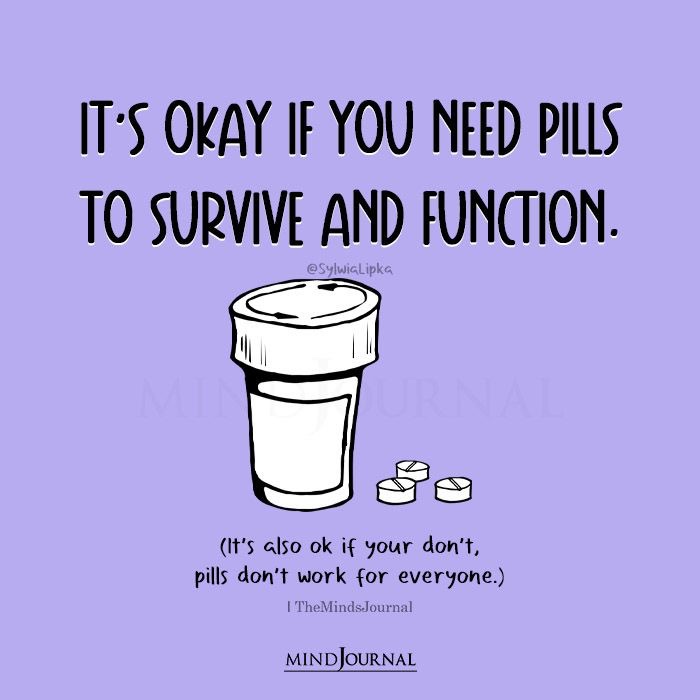
…I hit most of them. My primary care provider suggested a low dose of an antidepressant. At first I refused, I wasn’t open to the idea of trying an antidepressant. A replay of the past year and all the things that have happened and the struggles I’m having now clicked on in my mind. Ultimately I decided there’s nothing wrong with getting a little help.
So here we are…the first step is awareness, the second step is asking for/accepting help, and then the constant path before us is healing, learning, and growing. There’s nothing wrong with taking mental health medication to help you along your journey.
If you’re unsure if you’re in a cycle of depression, I encourage you to go back and reread the DSM-V criteria I listed above. Ask yourself the criteria in the form of questions: “Do I have depressed mood most of the day, nearly everyday?” etc. If you answer yes to 5 or more of the questions, and these symptoms are negatively effecting your day-to-day life, chances are you are experiencing depression and could benefit from talking with your healthcare provider and/or mental health therapist.
My boyfriend and I recently bought an above-ground pool in an attempt to get more exercise. I only swim after work when it’s dark outside. I love lounging in the water at night – I just float staring up at the stars. It’s quiet, the weather is cooler, and I don’t have to worry about getting sunburnt.
Usually my boyfriend is outside with me, but there’s been a couple of times when I’m there by myself. In dark, quiet isolation I find my mind to be anxious and spinning wild thoughts. Shadows are cast over the front of the pool, darkening out a third of it. The unknown of the darkness frightens me. My thoughts wander to worrying that anything could be lurking there, waiting to lash out and hurt me.
I have images in my mind of an alligator (one of my biggest fears) laying there just out of view; of a venomous snake coiled in an unseen area. I tell myself it’s ridiculous, the likelihood of that being true is next to impossible. Then my mind switches to a scene of an alligator creeping through the backyard, making its way towards me. I spend most of my time looking for alligators and snakes instead of swimming.
What a beautiful metaphor for the life of someone with an anxiety disorder. The unknowns, the darknesses that comes with life leaves so much room for our minds to try to fill in the blanks. We naturally want to be prepared for all the possible scenarios and outcomes. We want to feel a sense of control over our lives.
The part of us that worries, the part of us that does neurotic things to cope with our emotions, the part of us that is trying to keep us safe is just a former version of ourselves who at one time felt these overwhelming emotions and never wants to feel them again. They try to protect us and alert us to anything that may hurt us. When we give in to them we cope with what’s going on, but we may cope in an unhealthy way. Avoiding our feelings, turning to food, alcohol, drugs, etc to feel better, isolating ourselves, self-harming behaviors etc may help us to stop our feelings in the moment, but they are unhealthy and end up hurting us in the long-term.
If this is something you find yourself struggling with, please know it’s possible to live another way. If we’re willing to do the work, we can learn how to overcome the issues we struggle with. Step one is to acknowledge that you’re not thinking clearly – you’re having irrational thoughts. Step two is to begin working towards rational thinking.
What can we do to stop these irrational thoughts? One exercise used is called thought stopping. When irrational thoughts roll through my head, I literally tell myself to stop. I interrupt the thought process and then go down the list of evidence that proves those thoughts are irrational.
The more we think about negative things, the bigger a neural pathway we create around that subject. Do some research on neural pathways and see if it helps you understand what is going on inside your brain and why it’s so easy for us to automatically focus on the negative. Changing our thought process IS possible, but it takes consistent work! When you catch yourself thinking negatively, begin the exercise mentioned above, then add positive thoughts to replace the negative ones. Create new neural pathways!
Our thoughts, physical bodies, emotions, and behavior are all intertwined. When we make a change to one, the others follow! Being mindful and aware of what we’re thinking, feeling, and choosing to do is crucial to our healing.
No one said healing mental health issues were easy. It takes hard work, but it is possible to overcome the things that make you feel crippled now. Allow yourself to feel the emotions that arise and work through them. They will pass as they always do.
Journal prompt for the week:
Meet the part of you that is frightened with empathy and love. Who is that version of you? You when you were 5? 15? 30? What was going on at that time? What are they afraid of? What happened to cause this fear? Tell them they are safe, they are loved, and that you can take care of them and yourself now.
“That’s never going to happen. My kids will always come first.” My client gave a derisive snort and crossed her arms.
As a young therapist without much clinical experience or children of my own, I felt helpless. My client was young herself and struggling raising three kids, running the house, and working a full-time job. Her plate was full and free-time was nonexistent.
Her mental health was also struggling. She was over stressed, felt unappreciated, was becoming depressed and developing a very short fuse when it came to her temper.
I had just used the platitude “You have to put your oxygen mask on first…” and she was not having it. I don’t blame her. I roll my own eyes now when someone says that to me.
The truth is, when we reach a certain low point in our ability to do the day-to-day tasks, to bounce back from setbacks, or a low point in our mental health in general, hearing something like that can feel demeaning. How can I focus on myself when there’s so much more important things to do? If we don’t feel safe, secure, or supported in our daily lives how can we even think about the luxury of self-care and pampering?
It seems for some, my client especially, that taking time for oneself equates neglecting another area of their life. In her case, she felt self-care took away her value as a mother. Self-care = bad mom.
If I could go back now as a more experienced therapist I would tell her that the fact she cares so much shows she is a good mother. I would educate her on how thinking everything is black-and-white, all-or-nothing is a harmful way of thinking. I would tell her self-care does not equate self-ish.
Being present with your child physically doesn’t equate being present with them emotionally. Read that again. Children, especially very young children, crave nurturing, attention, and meaningful play and interaction with their parents. This is such an important phase of their life – so important that it can effect their friendships and romantic relationships in the future.
I’ve seen so many parents come to pick up their child from school while on the phone. They never even greet their children or hug them. I’ve had parents playing video games all night while their child watches an iPad until it’s time to go to bed. I’ve seen moms so focused on checking off everything on the to-do list that they never check in emotionally with their child.
What secure, gentle, true nurturing and bonding can be given from someone who is always stressed? Angry? Sad? Distracted? Too busy? Can you picture an interaction between a parent and child when the parent was clearly in one of these moods? What did it look like? Was it a positive interaction?
Self-care doesn’t have to mean long weekend retreats at expensive spas. It doesn’t have to mean giving up your quality time with your kids or neglecting their needs. In fact, there are many kid-friendly activities that you can do with them. Deep breathing, yoga, coloring, going for a walk, eating healthy meals, singing, dancing, etc. In fact, by doing this you not only are you being emotionally present with them, are teaching your children their own set of healthy coping skills.
I also want to stress that IT IS OK if you take some alone time for yourself. There are 168 hours in a week it’s ok to give yourself permission to take 30 mins, an hour to do something for yourself once a week. One small positive change can create a domino effect of positive changes. This is how we begin the journey of feeling better and more resilient.
Healthy self-care allows you to show up for your children, family, friends, work, etc as the best version of yourself. Yes, we can endure the stress; we can endure the storms and trials, but we’re not obligated to neglect our needs. We can have a healthy balance!
Journal prompts/thoughts for the week:
What type of parent do you want to show up as? What type of adult do you want your child to grow into? They’re constructing their future life experiences and belief systems based on what they see and experience themselves. In what ways are you leading by example?
I never knew the true impact of death until my mother died. I’d had family members die before; people I’d gone to school or church with, public figures I had admired.
Grief is a very complex emotion full of complicated feelings, fears, emptiness – my entire world was shattered and it’s like I’ve been in a meteor shower of shards of glass pelting me endlessly. Each shard is an emotion, a regret, a memory, a once dreamed vision of how I thought my future life was going to look. Each shard is something new to mourn.
I mourn my mother, yes, but I also mourn the experiences and memories I thought I’d be able to have with her. I mourn the loss of my confidant and sit with the secrets and dreams I now only keep to myself. I mourn the sense of safety and security that I felt deeply with her. I mourn the loss of family dynamics and traditions that she upheld. I mourn the carefree, naive version of myself that existed before she got sick.
Most of us are in mourning and aren’t even aware of it. The relationship that ended, the job that didn’t pan out, a friend moved away, financial loss, our lives not going the way we planned…there are little deaths we experience all the time, and it’s important to allow ourselves to feel and acknowledge these deaths.
I recently heard, “you have to let in to let go.” I know I’m guilty of finding ways to numb myself or distract myself when these yucky feelings pop up. I check out, so to speak. I avoid the feelings with food, my phone, TV, and video games. The problem is, the feelings don’t go away when I emotionally check out, they resurface again and again. It’s only when I let myself feel and emote these emotions can I move past them.
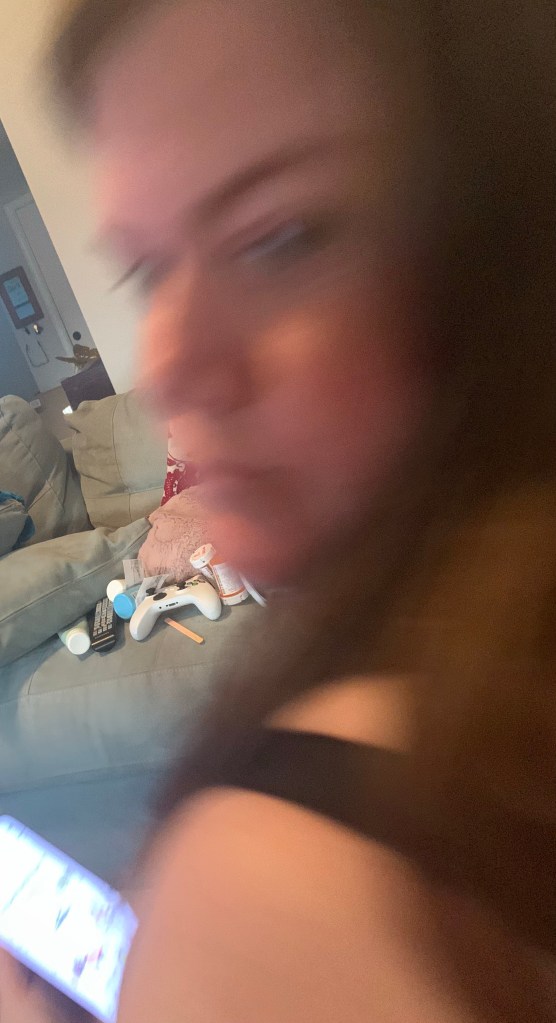
My boyfriend took this picture last night. I was giving him a hard time about taking more screenshots of his Pokémon than he took pictures of me. I started to turn away and heard the click of his phone as he grabbed this quick pic of me.
My first instinct was to tell him to delete it. It was a terrible picture. I never like how I look in pictures and there’s nothing I hate more than showing the clutter in the house. This picture shows both. Instead, I took a second look at it. Something about this picture spoke to me. It’s an accurate portrayal of how I feel my life is right now. It’s the truth behind the scenes…behind the smile…behind the public persona.
We’re in the middle of decluttering the house. We’re taking everything out of one space at a time and deciding what to keep, toss, or donate. It looked like a bomb went off. I couldn’t help to pause and take in the scene of chaos around me and see how it mirrored my life. It’s time for change, it’s time for letting go, and most importantly, it’s time for me to actively decide what I want my life to be. And it’s messy. And I’m sad. And it’s all part of the process.
It’s ok to make changes. It’s ok to let go. It’s ok to be sad while you’re growing, healing, and creating. Even if you feel like a blur, life will come into focus when you’re ready to take the steps needed to move forward.
It’s been a hot minute since I’ve posted anything. My mom died after an 8 month fight with Glioblastoma. And man did she fight. She never complained. Never asked “Why me?” She had a divine strength most of us only dream of.
And what now? Moments of closing my eyes and picturing her. Her hair. Her eyes. The way she would tilt her head to the left and smile at me like I was the best thing in her life. The warmth that caresses my face when I think of her.
The memories are there, yes. But honestly I’m tired of people telling me to hold on to the memories. All I can think of is how am I supposed to go another 40, 50 years of my life without her. This time last year I was with her, hugging her. Now everything has changed.
Then just as quickly as the tears came, they dry and I go back to whatever task I was doing. Grief is funny like that. One minute I’m devastated, sinking into the abyss, the next back to life as usual.
In the words of my mama, “This too shall pass.” And that’s the goal. Get through the messiness. Feel the emotions and then let them pass. Rest. Then take a step forward. I may not know what is ahead of me, but I have faith I will get where I’m supposed to be.
“To stay present in everyday life, it helps to be deeply rooted within yourself; otherwise, the mind, which has incredible momentum, will drag you along like a wild river.” -Eckhart Tolle
A few years ago my parents planted 3 trees in my side yard. The instructions that were given for their care was to water them for an extended period of time so the roots would begin growing down into the soil and take root where they were planted. One died pretty quickly. Admittedly, the trees were planted during a tumultuous time in my life and I neglected to water them as often and as long as I was instructed. I kept hope that it would rebound, but it never did. I decided to remove the tree and was surprised at how easily the tree was to lift out of the hole. The roots had never grown down and into the ground.
How does this quote apply to someone whose roots were never watered? Or for whatever reason wasn’t tended to as needed?
In a previous entry I talked about how my thoughts started bombarding me after listening to an old mix tape made in the 90s. Well they haven’t stopped. They’ve snowballed in fact. I find myself in the middle of repeating a scenario where I felt I was being a bad person or felt embarrassed. This scenario spawned from another scenario I was reliving. That from a previous scenario. And I have to backtrack how I even got on this line of thought to begin with. It’s like I’m punishing myself, or making sure I know that I’m a bad person.
So what if my identity is rooted in being a bad person? Or an unworthy person? Or a failure…or the thousand other dark thoughts that lead in the direction of depression and anxiety. I think this is where a lot of us get stuck. I inherently know that I’m a good person and make mistakes like any other human, but I didn’t always know that. My identity was being an overweight, socially awkward, lazy screw-up. How can being deeply rooted in toxic sludge prevent me from getting swept away in the raging river?
Sometimes I think embracing this toxic identity is a great way to deflect responsibility for the mistakes I make. I’m a screw-up…of course I’m not going to succeed, so no need to try. I’m socially awkward – it’s too hard to go out and try new things and be around people. I’m lazy…you should have known I wouldn’t have done the work. It’s your fault for even expecting me to do it in the first place.
If I’m such a terrible person, then the crappy things in life make sense. I deserve to suffer. I deserve to hurt….why else would these crappy things be happening to me? I think our brain tries to makes sense of the world around us in the best way it can at the time.
These may be character traits and flaws we don’t like about ourselves, but it’s not who we TRULY are. It’s one aspect amongst a million other aspects. So who are you really?
You can’t be deeply rooted in yourself if you don’t know who you truly are. Most of us are still operating on the narrative that others told us we were. Every person you meet creates a version of you in their mind. The vision one friend has of you is different from another friend. Which version is true?
We have to start figuring that out – we have to intentionally set out to discover ourselves.
An exercise to try: create a written list of things you believe you are, both positive and negative. Or, if you’re artistic, draw a picture of yourself and then write the labels others have given you.
Now delve deeper. Do you agree with these labels? Ask a trusted friend or loved one: do they agree with the labels?
What labels do you see in yourself? What labels would you like to have?
My mom died last week. This is the biggest thing I’ve been scared of my whole life. She had been diagnosed with an aggressive form of glioblastoma in June 2022, and we knew from that day forward what the ultimate outcome was going to be. Even with 8 months to prepare, it’s still a shock. How can you ever be ready for this?
For the most part, I’m numb. The past week has been a whirlwind of planning, being surrounded by people, answering the same questions, giving the same canned responses, forcing smiles, and just powering through the days. And now there’s silence. Now life continues on while feeling as if it’s at a complete stop at the same time.
Every now and then the numbness wears off and I just feel lost. Or in denial that she’s really gone. All I really know is that my life is forever changed. I’m forever changed. And this is the time in between…the time where I come into something new, but it’s still forming and taking shape around me. I’m smack dab in the middle of transition.
Dealing with loss can be one of the most difficult experiences to go through. Whether you’ve experienced a death or the dissolution of a relationship, it’s normal to feel sadness, anger, confusion, and despair.
People talk about a “cycle of grief.” I don’t really see it that way; I see it more as a wave that fluctuates between a wide array and degree of emotions. Society today, however, knows it as the grief cycle. While I believe it to be more complicated, grief is typically taught as the following stages:
Denial When we first experience a loss, we may go into a state of disbelief. We may feel paralyzed and unable to accept what has happened. This stage can be a form of self-protection, as denial can allow us to accept the loss more slowly and better manage the initial shock.
Anger Whether it’s outwardly expressed or internally directed, feeling angry is a normal response to loss. We may find ourselves taking out our frustration on those around us, leading to arguments and tense situations. It’s important to take care of ourselves during this stage, and instead of taking out our frustrations on others, find ways to express it in healthy ways.
Bargaining When we’re in the bargaining stage, we may go through our heads, searching for ways to undo the loss. We may find ourselves looking for explanations, justifications, and even solutions. But it’s important to remember that, ultimately, this stage is futile and you’ll need to come to terms with the loss.
Depression Depression is an inevitable outcome of grief. At this stage, we come to accept the truth, and that can result in an overwhelming feeling of sadness and despair. While it’s important to acknowledge this emotion and take the time needed to properly grieve, you can also seek help from a mental health professional who will be able to provide tools to help manage the depression.
Acceptance The final stage of grief is acceptance. We can come to terms with the reality of the loss and find a way to move forward with our lives. At this stage, we may be able to find a sense of peace and even recognize the positive changes that come with the loss.
Grief is an individual experience and no two people are likely to go through the 5 stages in the same way. Everyone has their own unique reaction to loss, and the key is to allow yourself to fully feel whatever emotion comes up in the moment.
How do we process these huge losses? Create a way to express your emotions in a healthy way:
write
Draw
paint
create a physical memorial
bake their signature dish
Write letters to them whenever you feel the need to speak to them.
Find a support group or therapist.
What ways do you remember and honor your loved ones?





 Unbound Light