
Let’s have a crash course in anxiety. There’s many different types of disorders and new names and flashy pop psych phenomenon popping up all the time. All these disorders have something in common, but have different symptoms that set them apart from each other. Fun fact: anxiety disorders are the most common mental health condition in the US effecting over 40 million of the adult population. Most people experience symptoms before the age of 21.
Anxiety is what I call an umbrella emotion. It has one label, but covers a multitude of other emotions like fear, dread, restlessness, irritability, hypervigilance, anger, sadness, etc.
I, myself, have 2 of these disorders: Generalized Anxiety and Social Anxiety. So basically, when I’m not worried about being around people and socializing (among other things), I’m just worried about everything else in my spare time. I say this in jest, but it’s also the truth. Luckily some days are better than others, and as I’ve learned more about myself and healed, it’s lessened over time.
Anxiety is a real thing, and the toll it can have on our brains, emotional state, and bodies is a real thing. When we become scared or anxious our body responds by releasing chemicals and hormones. These chemicals and hormones cause physical reactions. Some of the most common responses are an increase in heart rate and blood pressure, our muscles tense, shallow breathing, etc. Our body goes into fight mode. How do you think we feel after we go through all this? Tired! And no wonder…so much energy is being used during this time.
If you think of your body like a cell phone battery – what percentage of battery do you use during an anxious episode. How many anxious episodes do you have a day? A week? A month?
Not only are we using energy during these episodes, it also takes energy to manifest and manage the anxiety.
Manifesting anxiety???? Whaaaaaat? Yes, we do it all the time. Our thoughts, emotions, behaviors, and body are all intertwined. At the height of my social anxiety I was convinced that everyone was watching me, scrutinizing my every move, and making fun of me. I was constantly having an unhealthy inner dialogue with myself and looking for evidence to prove my thoughts. I dressed in a way where I thought I was hiding from people, but I was really standing out. I did things in an attempt to hide, but brought more attention on myself. I was causing the very thing I was trying to avoid!
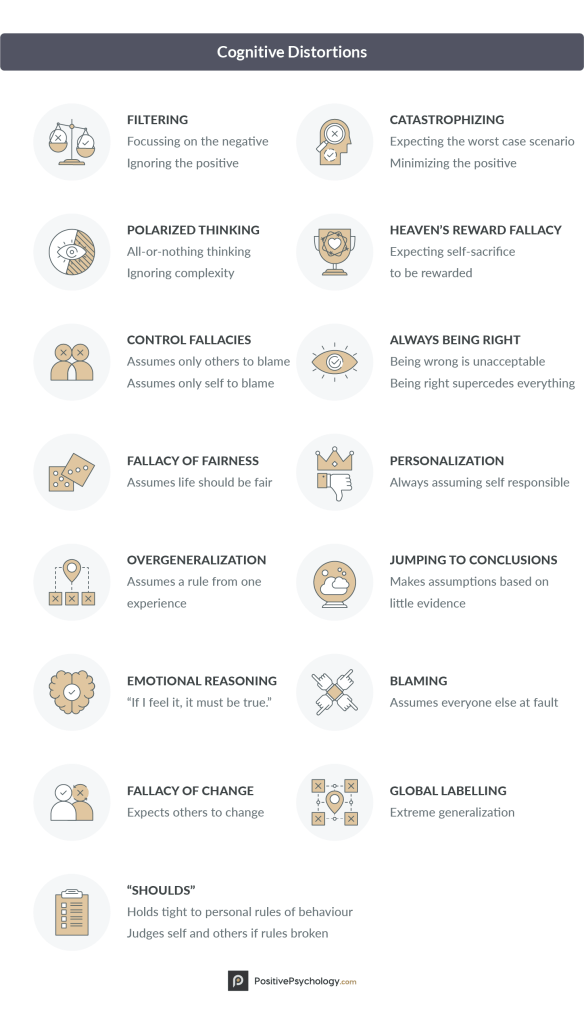
Your feelings are valid. Your physical symptoms are valid. Now the challenge is figuring out if your way of thinking is valid. This week I invite you to take a look at the types of cognitive distortions below and identify which ones you use. Awareness and knowledge are always the key to recovery!
Ugh, then there’s our thoughts. If I had a dollar for every time I told myself I should do or be or say a certain thing… or looked at a benign situation and created a disaster scenario… These are called distorted thinking. It’s a pattern of thinking that’s effected by irrational beliefs and not based on facts. We get into habits of thinking a certain way that is based in negativity and negatively impacts us.
Below is a list of common cognitive distortions. Which ones do you resonate with? Awareness is always the first step in working towards change and growth. Once you realize that your beliefs and thoughts are impacting your anxiety and behaviors, you can begin challenging and correcting them.
Ask yourself:
- What event triggered these thoughts?
- What are my beliefs/thoughts about the event?
- What were the consequences of thinking this way?
- What evidence proves these thoughts about the event are true?
- What are the alternative reasons why the event occurred?
- What can I do differently next time?
 Unbound Light